Music, History, Women, and Heritage

Tag: washington dc

Who was William Henry Browne? Part 2

[Continued from Part 1 of this blog]

The New-York Observer honored William Henry Browne after he was wounded at the Battle of Salem Church, Virginia, writing, “Even if crippled for life, he glories in his sacrifices for the Union, and the honor of the national flag.”1

Bone from a deer leg is shone shattered by a minie ball
Field Hospital, Gettysburg Reenactment, July 21, 2010 (Photo by the author)

Minié balls were among the deadliest weapons on the Civil War battlefields. These bullet wounds accounted for a high percentage of amputations in Civil War hospitals. Months of recovery followed the fighting at Salem Heights for William Henry, but he was unusually lucky to survive the ordeal, when so many soldiers lost a limb through amputation, or died from infection and gangrene in the wound.

Who was William Henry Browne? Part 1

Sticky post

Who was William Henry Browne? Some five years younger than his sister Augusta Browne, William Henry left a personal mark in U.S. history as a Union brigadier general in the Civil War, and as the preeminent American authority on trademark law during the nineteenth century. The lives and activities of Augusta and William Henry grew ever more interwoven through their adult years. During the 1870s, the brother and sister worked together on music performances and songwriting, culminating in a series of campaign songs for Rutherford B. Hayes, the Republican presidential candidate in the 1876 election.

Katherine Quail Pearson, Washington, DC, Organist

When I attend concerts at the Church of the Epiphany in Washington, DC, I feel that I have entered Augusta Browne’s world. She would have known the church well, and its organist, Mrs. Q. A. Pearson. This profile of Kate Pearson focuses on a lesser known but significant player in the musical life of Washington, DC, during the Reconstruction era and her connections to Augusta Browne.

Kate Quail was just twenty when she assumed the post of organist at DC’s Church of the Epiphany (Episcopal). Barely three years later, the Washington Evening Star paid a handsome compliment to the young woman in its preview of music planned for Easter morning, April 7, 1871, noting that her “ability as a musician is well known.”

Church of the Epiphany chancel and altar (Photo: the DC Bike Blogger on WordPress.com)

A Room of Her Own in Nineteenth-Century America

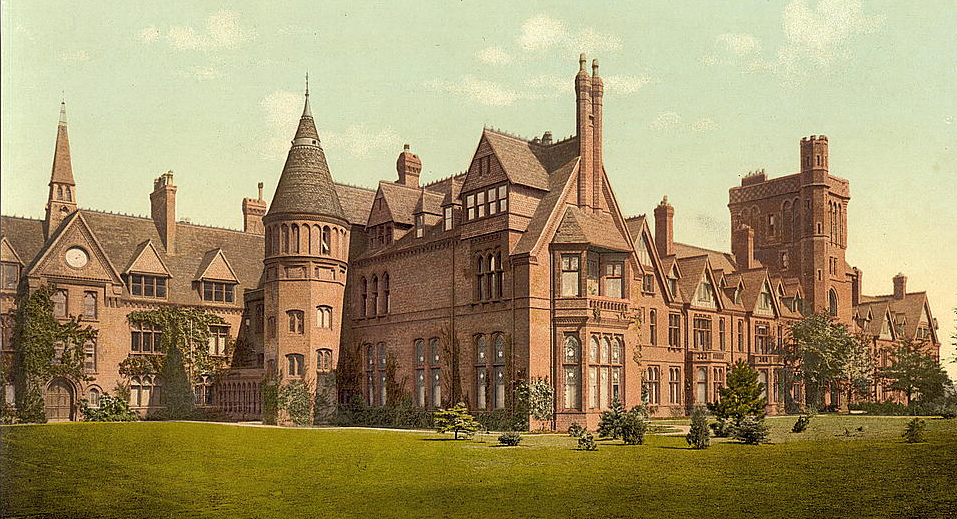
Virginia Woolf wrote “A Room of One’s Own” to deliver in 1929 at Cambridge University for attendees of the two women’s colleges: Girton (est. 1869) and Newnham (est. 1871).

Colored photograph of Girton College, Cambridge
Girton College, Cambridge, England, ca. 1890–1900. https://www.loc.gov/item/2002696455/

Woolf expanded the seven thousand-word essay into a monograph that remains a touchstone of the feminist movement. [see http://gutenberg.net.au/ebooks02/0200791.txt]. Her argument asserted that “a woman must have money and a room of her own if she is to write fiction.” The formula was much the same for a nineteenth-century female author, i.e., a woman needed to find money (have it, get it, or earn it) and a room of her own to enable her to write.

To paraphrase Virginia Woolf, American composer and author Augusta Browne (ca. 1820–82) did have a room of her own, although—like Emily Dickinson (1830–86)—it was in her parents’ residence.

Powered by WordPress & Theme by Anders Norén