Who was William Henry Browne? Some five years younger than his sister Augusta Browne, William Henry left a personal mark in U.S. history as a Union brigadier general in the Civil War, and as the preeminent American authority on trademark law during the nineteenth century. The lives and activities of Augusta and William Henry grew ever more interwoven through their adult years. During the 1870s, the brother and sister worked together on music performances and songwriting, culminating in a series of campaign songs for Rutherford B. Hayes, the Republican presidential candidate in the 1876 election.
Women could not vote in national elections when Augusta Browne Garrett participated in the 1876 presidential campaign.[1] Nevertheless, seventeen songs contributed by Browne Garrett and her younger brother, General William Henry Browne (1825–1900), appeared in the pocket-size Hayes & Wheeler Song Book as part of the 1876 election battle. Although Browne Garrett never advocated for women’s suffrage in her extensive published prose, her contributions to the 1876 presidential race heralded American women’s future political activity.

The Republican National Committee distributed the Hayes & Wheeler Song Bookfrom coast to coast during the contest between the Republican candidate, Governor Rutherford B. Hayes of Ohio, and the Democrat, Governor Samuel Tilden of New York.[2] Victory for Hayes ultimately came down to a single electoral vote, making this contest the most disputed presidential election of the nineteenth century.
Where can I see sheet music by Augusta Browne? How can I hear music by Augusta Browne? These are the questions people ask most frequently about the composer. On the Music Editions page of this website, you will find links to open-access databases that include nineteenth-century imprints of music by Browne. The Music Editions page lists more than eighty music titles available online. The entries are arranged by genre (piano pieces; songs; hymns), then alphabetically by title.

Look for “Listen to the Music” links on the Music Editions page for online performances of music by Augusta Browne. Some renditions are recorded performances, others are audio files generated from Finale music notation software.
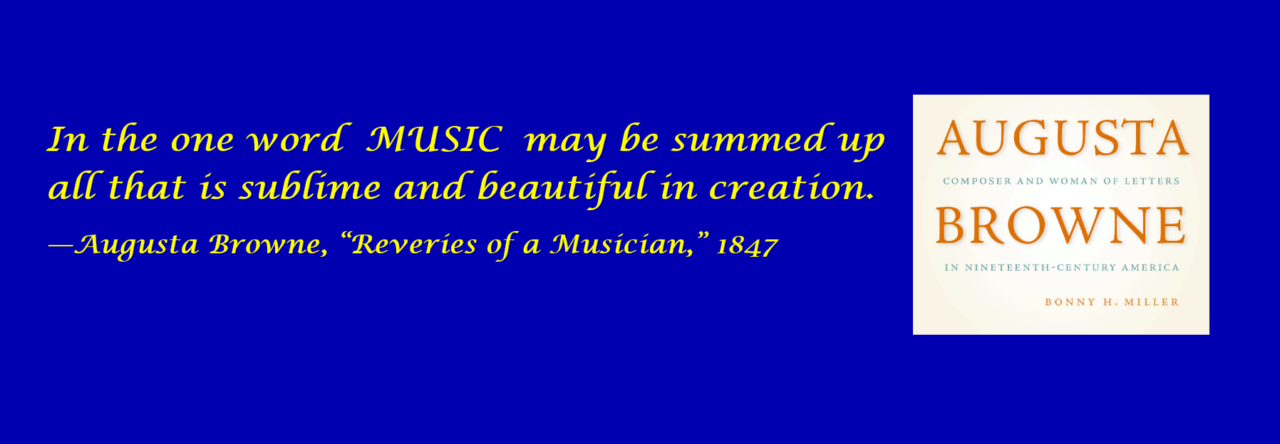
AUGUSTA BROWNE
Composer and Woman of Letters in Nineteenth-Century America
Bonny H. Miller
Use promo code BB135 to receive your discount.
Augusta Browne Garrett (ca. 1820–82) was one of the professional women musicians most active in publishing sheet music in nineteenth-century America. Her lively songs and piano solos, prose, and music journalism present an engaging period voice neglected for too long.
To order Augusta Browne, click on the link below and follow the instructions through checkout. Add promo code BB135 to receive 35% discount:
TO ORDER, please visit our secure website at https://boydellandbrewer.com/9781580469722/augusta-browne/

The 2021 H. Robert Cohen/RIPM committee of the American Musicological Society expressed “high respect” for the “superlative quality of Bonny Miller’s work” and awarded Honorable Mention as a “mark of distinction” for Augusta Browne: Composer and Woman of Letters in Nineteenth-Century America. The H. Robert Cohen/RIPM Award is awarded by the AMS each year for outstanding work based on the musical press.
“Bonny H. Miller’s Augusta Browne is a superb piece of musicological scholarship. Every chapter reveals methodological mastery, nuanced analysis, engaging writing, and contagious enthusiasm for restoring a historical figure who has been undeservedly neglected.” [Journal of the International Alliance for Women in Music]
“The author deftly sets up the forces in Browne’s life, both from her family, training, and social class, and from the wider cultural world surrounding her.” “engagingly written” “richly contextualized” [Journal of Musicological Research]
“This biography is an inspiration and should be included in any graduate-level research methods class for future scholars to learn from Miller’s methodologies.” [Music Library Association Notes]
ISBN: 9781580469722; 480 pp., 20 b/w & 50 line illus., Eastman Studies in Music
Library ebook ISBN: 9781787448834
[Continued from Part 1 of this blog]
The New-York Observer honored William Henry Browne after he was wounded at the Battle of Salem Church, Virginia, writing, “Even if crippled for life, he glories in his sacrifices for the Union, and the honor of the national flag.”1

Minié balls were among the deadliest weapons on the Civil War battlefields. These bullet wounds accounted for a high percentage of amputations in Civil War hospitals. Months of recovery followed the fighting at Salem Heights for William Henry, but he was unusually lucky to survive the ordeal, when so many soldiers lost a limb through amputation, or died from infection and gangrene in the wound.
“Music! the electric telegraph of the heart, having its termination in Heaven.” With these poetic words, Augusta Browne began an 1849 essay in the Message Bird, a fortnightly New York journal of the arts. I find it one of her most engaging aphorisms, comparing the power of music to convey love, grief, or joy, to the near-instant function of Samuel Morse’s telegraph to transport words and messages.

Augusta’s admiration and enthusiasm for the new technological marvel suggests a progressive young adult of her era. But there was more to it than just the innovation in communication. A chain of connections between Morse, the telegraph, and Augusta Browne emerges from her life and family story like a series of electric bulbs lighting up.
The American composer Augusta Browne was not Lady Augusta Browne (1838–1909), ninth child and sixth daughter of Howe Peter [Browne], 2nd Marquess of Sligo (1788–1845). A photograph of Lady Augusta Browne is frequently displayed and misidentified as an image of the composer. The two unrelated women were born in Ireland almost twenty years apart. Lady Augusta Browne sat for portraits and photographs because she was a member of the minor British peerage in Ireland. Her carte-de-visite from the 1860s belongs to the National Portrait Gallery in London. Lady Augusta Browne never married and led a quiet life in Westport, County Mayo.

Lady Augusta Browne
by Numa Blanc & Cie
albumen carte-de-visite, 1860s
NPG Ax46406
The image of Lady Augusta Browne in the Victorian-era photo does not depict the American composer.