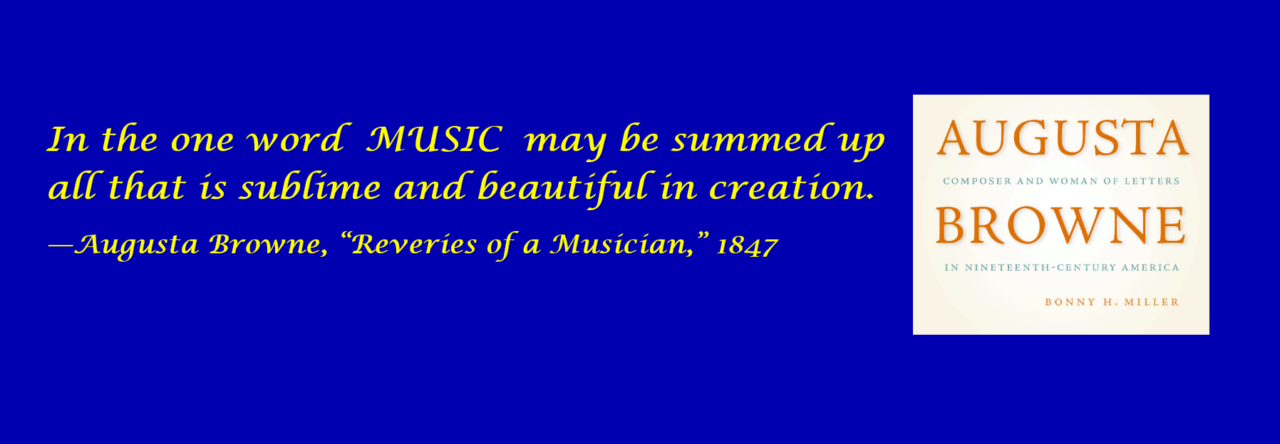
“Music! the electric telegraph of the heart, having its termination in Heaven.” With these poetic words, Augusta Browne began an 1849 essay in the Message Bird, a fortnightly New York journal of the arts. I find it one of her most engaging aphorisms, comparing the power of music to convey love, grief, or joy, to the near-instant function of Samuel Morse’s telegraph to transport words and messages.

Augusta’s admiration and enthusiasm for the new technological marvel suggests a progressive young adult of her era. But there was more to it than just the innovation in communication. A chain of connections between Morse, the telegraph, and Augusta Browne emerges from her life and family story like a series of electric bulbs lighting up.
With experimentation over a period of years, Samuel Morse (1791–1872) developed the electromagnetic telegraph, his ingenious combination of battery, wires, and signaling code that would change the world with the scriptural words, “What hath God wrought,” sent in Morse code via an electric line between the US Capitol and Baltimore on May 24, 1844. A week later, the Baltimore Sun declared that, with this advance, “Time and space have been completely annihilated.”1
Morse was a Renaissance man who had begun his professional life as a portrait painter. One of his works, a monumental painting depicting a collection of masterworks from the Louvre, was intended to teach Americans about the beauties of Italian masters in an era before art museums existed in the United States. In “Gallery of the Louvre” (1832), Morse rendered small reproductions of thirty-eight Old Master paintings in a single large canvas, a picture that he hoped to take on tour, charging entrance admission.
Even though his money-making schemes as an artist didn’t succeed, Morse founded the National Academy of Design in New York City, which continues to maintain a cultural presence in the city. He served as the National Academy’s first president and taught there for years while he improved his telegraph apparatus, even stringing telegraph wires around his art studio for his transmission experiments.

Augusta’s youngest brother, Hamilton, petitioned to study at the National Academy of Design as an eleven-year-old and received special permission to attend evening classes.2 Hamilton displayed tremendous artistic talent and won every competition he entered. The Browne family would probably have known Samuel Morse through this relationship alone. But Hamilton’s tragic death at age twenty from tuberculosis did not end the connection with the National Academy. Augusta remained involved through other artist friends and her husband, J. W. B. Garrett, who showed paintings at the Academy during the 1850s. Moreover, the artistic tie is not the only one that linked the Brownes to the Morse family.
Samuel had two brothers, Richard and Sidney Morse, involved in journalism in New York City. They edited and ran a prominent Presbyterian weekly newspaper, the New York Observer, which occasionally published essays by Augusta Browne Garrett during the 1860s and ’70s. She would have counted the Morse brothers as friendly acquaintances and vital professional contacts. They provided one of the most systematic and prominent publication venues for Browne’s essays on music and religious reform.
Augusta Browne also engaged with a darker side of the Morse brothers. Samuel Morse was a co-founder and vigorous advocate for the anti-immigrant, anti-Catholic Native American Democratic Association (later known as the “Know-Nothing Party”). A decade before the Great Famine, when New York became the port of entry for tens of thousands of desperate Irish immigrants, he encoded these prejudices in an 1835 publication, Foreign Conspiracy Against the Liberties of the United States.3
American Protestants deeply mistrusted papal power, which they regarded as despotism that would lead to disloyalty to the United States among Irish-Americans, and the influence of Catholic educators—especially the Jesuit order—on American youth. Augusta echoed similar anti-Catholic sentiments in her essays, such as “Romanism Among Us” (The Advance, January 21, 1869) and “Are We to Have a St. Jonathan?” (New York Observer, March 21, 1878).
But she already had a small presence in a rabid anti-Catholic paper in New York City as early as 1842, when she was mentioned as a promising young organist by the Protestant Vindicator. The Vindicator laid out its mission in its full title: The Protestant Vindicator in Defence of Civil and Religious Liberty Against the Inroads of Popery. Augusta had volunteered to play for the lecture series of the Protestant Reformation Society in January and February. The president of the Protestant Reformation Society and editor of the Protestant Vindicator, William C. Brownlee, tried to assist Augusta’s professional recognition by inserting snippets about her new sheet music publications in the paper several times in 1842.
Although Augusta’s interaction with the Morse family was principally with the newspapermen, Richard and Sydney Morse, she doubtless followed the eventual triumph of Samuel’s telegraph demonstrations in 1844 and his later struggles to finance a network of telegraph lines across the US. A permanent transatlantic cable began operation in 1866.
Many national tributes honoring Samuel Morse took place following his death in 1872. A grand memorial service for Morse held at the US Capitol on April 16, 1872 (pages 47–49 in above), included a poem written by Augusta’s brother, William Henry Browne. Augusta, William Henry, and their mother had moved to Washington, DC, after the Civil War, when her brother began to work at the US Patent Office in 1868. Their home on Third Street NW stood not far from the Capitol, its great dome finally completed in 1866.
The lyrics of William Henry’s poem were set to music taken from Richard Wagner’s opera, Tannhaüser, and the all-male Choral Society of Washington performed the number during the somber memorial tribute to Morse in the Capitol. The poem was her brother’s, and the music was Wagner’s familiar “Pilgrims’ Chorus,” but Augusta may have been responsible for arranging the poem and music in the choral setting.
Whether or not Augusta worked on the choral arrangement, she was probably in the audience at the Capitol ceremony. In my biography of Augusta Browne is a musical example that suggests what the choral arrangement of her brother’s poem might have been like.4
Immortal mind, now in heaven beholding
The wondrous scenes all in glory unfolding.
Thy Lord hath said, “LET THERE BE LIGHT!”
And darkness dies in the radiance bright!
Thou now canst speed like flashing thought,
Again exclaim, “WHAT HATH GOD WROUGHT!”
Thy toil hath rich fruition found;
Glad soul, thou art a hero crowned!
Thy fame goes forth on the wings of the morning,
The lightning-steed the wide continent scorning.
Thou spirit blest! thy toil is o’er;
Thou art with God for evermore.
Hallelujah! hallelujah, for evermore,
For evermore!

Come, raging storms!—but your fury is broken,
For tongues of fire of your coming have spoken,
And sons of toil, on land and sea,
Defiant smile in security!
O subtle power! the dream comes true
Of him whose toy the lightning drew.
O joy! all great co-laboring minds,
Your genius now all nations binds.
Good-will, fly forth on etherial pinions,
Fly! harnessed light, to remotest dominions.
While thoughts sublime to heaven soar,
O, GOD! be guide for evermore.
Hallelujah! hallelujah, for evermore.
For evermore!

Members of the telegraph industry raised money to fund a handsome statue of Samuel Morse in New York’s Central Park while the inventor was still living (https://www.villagepreservation.org/2021/04/27/samuel-f-b-morse-a-brilliant-artist-and-inventor-with-a-complicated-troubling-legacy/ accessed July 10, 2025). Morse’s left hand rests on a telegraph. In his right hand, he holds a strip of paper with the message sent in 1844, “What hath God wrought.”
Morse’s final telegraph message, sent during a great celebratory evening for the eighty-year-old, offered “Greeting and thanks to the Telegraph fraternity throughout the world. Glory to God in the Highest, on Earth Peace, Goodwill to men. S F B Morse.” Samuel Morse and his two brothers are buried in Green-Wood Cemetery in Brooklyn, NY, as are Augusta Browne Garrett and her youngest brother, Hamilton Browne.5
In view of all these intertwined connections, Augusta Browne’s description of music as the electric telegraph of the heart takes on a host of allusions to the Morse family. The multiple references in her words emerge from dots and dashes found in scattered data from several decades, almost like a message sent in Morse code.
- “The Magnetic Telegraph,” Baltimore Sun, May 31, 1844. ↩︎
- Augusta Browne, Hamilton, the Young Artist (Philadelphia: Lippincott, Grambo, 1852), pp. 34–35. His full name was Alexander Hamilton Coates Browne (1830–1850), but he preferred to use Hamilton or Hamilton A. C. Browne. ↩︎
- Samuel F. B. Morse, Foreign conspiracy against the liberties of the United States (New York: Leavitt, Lord & Co. 1835). ↩︎
- Bonny H. Miller, Augusta Browne: Composer and Woman of Letters in Nineteenth-Century America (Rochester, NY: Univ. of Rochester Press, 2020), p. 200. ↩︎
- Other Browne family members are also present, but General William Henry Browne is buried in Arlington National Cemetery. ↩︎
Ralph P. Locke
A wonderful essay, pulling together what might seem like stray and unlikely bits of information to suggest important connections that might otherwise remain unknown. Augusta Browne didn’t write her life story, but you’ve done it for her so splendidly in your book, and now here’s a fine specimen of your ability to connect dots and bring history alive again. Brava!